skip to main |
skip to sidebar
As you get a more established garden, you can experiment with many different plants to see how well they might be able to be used as a ground cover/living mulch. In this area the European Wild Ginger, Asarum europaeum, in the forefront has filled in nicely. In a closer look you can see how it has grown right around the Fringed Bleeding Heart and it is moving beyond, right towards the Tiarella and Hosta. It will eventually fill in the area while allowing the other plants to keep coming up through the spreading Ginger.Wild Ginger requires full to partial shade
.
It is an evergreen, which means that the leaves remain year round. I love the contrast of the glossy deep green leaves against the delicate leaves of the Fringed Bleeding Heart. Ginger does have a blossom, but it is very non distinct and can be found under the plant in the spring.

Another plant which you may not think of as a ground cover is our native Violets, Viola, which are plentiful in my whole yard! I brought a few plants in from my Auntie Joe's home, where she lived until she was 93 (and lived five more years at my cousin's). (See my epiphany for more on this tale)
We had violets and Lily of the Valley in the home I grew up in and I have such fond memories of picking them and making wonderful bouquets of the deep purple Violets and white tiny bell spikes of the Lily of the Valley. So it was a no brainer that I would have lots of Violets here in Wrentham. This is an area adjoining our drainage "pit" we had to construct due to the wetlands we are on. I planted six small Rosina Violets here over twenty years ago, and now they make a beautiful cover on this whole slope.

They are a beautiful deep rosy color blanketing the area with their reddish/purple blooms in the spring.
 I also have planted several other colors, which have intermingled over the years and create such beautiful combination of hues of purples to whites and rose throughout the spring.
  There are several spots where the violets have taken over prior grassy spots, which has worked out quite well as we have been working on shrinking our lawns for years now.
 These Hosta, in a deeply shaded wooded nook, are being greeted by the violets running up from the lawn to join them in their nestled spot under an old Maple tree.
  In the top of this photo you can see a great ground cover creeping across the front of the Daylily bed. This is Thyme, a great herb which doubles as a living mulch.
  This is a closer look at Golden Thyme.
  Here you can see regular and Golden Thyme coming together is a great profusion of herbal glory.
  Here you can notice how this Cleome is enjoying how the Thyme is keeping her feet cool on a warm day.
  And here is Thyme blooming in her purpled, spiked splendor, cascading all over the front walkway,
  while here the Golden Thyme shares its blooms with all the Daylilies.
I have found Hosta to be quite generous in their growth habits, and easily forming living mulch around trees and shrubs,
 as well as around other larger Hosta.
  You can see from this picture that these hosta have tried gallantly to keep the Sundrops in check, while a few outgrew their ranks and are trying to infiltrate the Hosta!
 Pulmonaria is another plant that has grown into a great living mulch,
 as well as the Asters under this Butterfly Bush.
 I so enjoy watching how my gardens develop. Over time they take on a life of their own and I am convinced that I am just their servant in this journey I called my life.
It is so wonderful walking around the gardens and seeing so many areas beginning to take some orderly shape. There has been so much help in the gardens that I want to show you the progress we are making.
This spot, just under the Globe box was so over run with weeds that this beautiful Autumn Joy Sedum was totally hidden. Thanks to Joyce, the beautiful plant is now thriving.

I added in more loam to bring the soil level back to what is was before all the weeds were removed and transplanted two varieties of sedum in front of it to become "living mulch" for this plant. Living mulch is a term used for plants that are specifically used to take the place of mulch.
This is a Sedum that I use a lot for ground cover (living mulch). It will take root easily from stem cuttings, or loose pieces, and fills in beautiful, allowing other perennials to grow up through it in the spring. It forms a dense ground cover that rarely lets any weeds come up. I have found it to do well in full sun to full shade, though it thrives best in full sun. This is a current photo of a very small piece that I moved here in May. It has already tripled in size.  Here are three pieces of Sedums that I put in, in front of the Autumn Joy Sedum pictured above. These will fill in beautifully by the end of the season.
 This is the area at the end of the renewed path where lots of Black Eyed Susans and Blanket Flowers used to reside. This whole area is one I worked on weeding with Diane M. (Thanks Diane) so that people would be able to come in and dig up the Black Eyed Susans and other plants needing to be taken out. (Thanks Kathy and Steve)
You can see a huge plant, tied together that is leaning over. Krissy helped me to pull it together and tie it to make room for other plants that were getting trampled by the too leggy Tansy. I had left it to grow this spring so everyone could see how big they can get, when allowed free will!! Everything needs a little structure now and again. Some would call it discipline, but in this case, the Tansy was just reaching its full potential with no direction
So now I am getting ready to work with it. It will need to be cut way back, then divided and replanted in an area where it won't be bothering other plants. I have most of my Tansy at the end of the driveway all by itself, so that it can do just that, whatever it wants. Actually, as I already have plenty, this plant will get divided and sent home with adoptive families. Maybe you need Tansy in your garden. It would make a good project for after my vacation. It is too valuable a plant to not have in the garden. Tansy is the host plant for Ladybugs. Ladybugs eat aphids, which can destroy a garden. They lay their eggs on Tansy. It is a fascinating process to watch their larvae develop right on the tansy leaves. Years ago, Tansy was the first plant usually introduced into a perennial garden, for its ladybugs.  This area was totally filled up with Indian Blanket (Gaillardia) and other seedlings. Thanks, Diane M., for helping to get it cleaned out.
 This is the area right behind the wonderful watermelon plant behind the Blue Spruce. Mia worked out here with me one night recently, and we got the watermelon extra room to spread out in.
 We even discovered a new watermelon we had not been able to see through all the weeds! It is growing just great. This is the first time we have tried to grow watermelon.
 Here you can see the small patch of weeds left to get rid of, which will be easy now that we have identified all the seedlings we want to save for adoptions. And in the forefront of this photo you can see all the little seedlings waiting for new homes. There's Rose Campion, Liatris, and a few Donkey Tail Spurge already got taken.
  This is the Red Twig Dogwood right between the two beautiful Hydrangea up near the house. I keep this pruned to allow for the stems to get the deep red at the end of the season.
 These look just spectacular when there is snow, with their red stems coming up in the clean, white snow!! As it needed to be pruned, I took the opportunity to show Diane M. what can be done with pruned branches.
  This is the trimmed bush, stems ready to turn red in the fall, all prepared for their dazzling winter show.
 In this case, I used them to create a living fence. You put the bottom end into the ground, curving the top part over and into the ground creating a nice curved section of "living fencing"!
 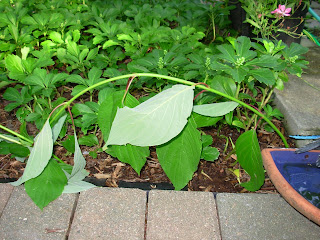 The stems will root, and there will be many rooted Red Twig Dogwood stems for people to take home to start their own bushes for future winter glory!
 This post has been an interesting progression. Started Tuesday before all the company arrived, and got continued over the course of 7 hours today, fitting it in as I could with the grandkids here. Lots of interruptions, as happens with young children!!
As it has been raining steadily all morning, I am soaking up the cool air throughout the house, and am comforted with the knowledge that all outside is getting a well deserved soaking renewal!! Hoping you all can also enjoy this renewal process, knowing how great everything is going to be glowing in the next sunshine!


